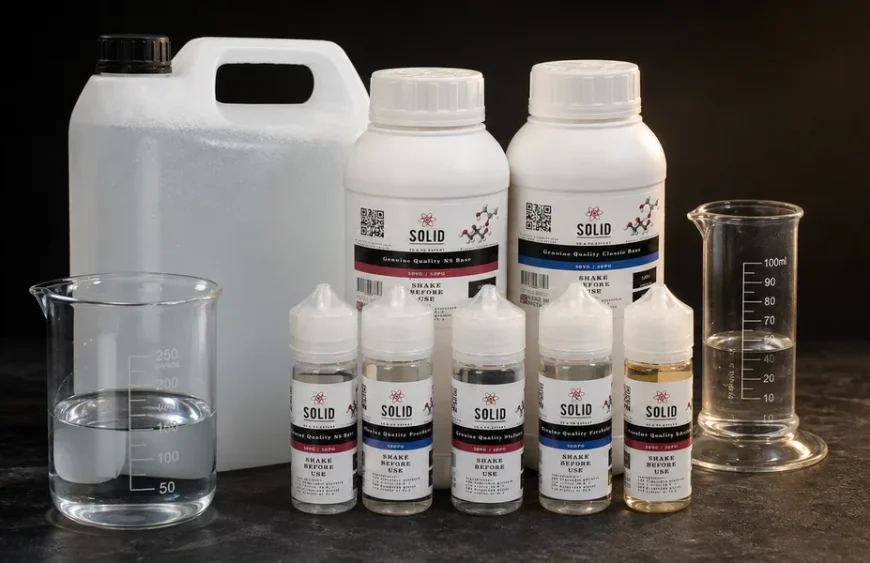
This e-liquid base guide explains how VG/PG ratios change viscosity, flavour delivery, throat feel, and vapour before nicotine or aroma is considered. The right ratio is not simply the one that makes the largest cloud. It must wick reliably in the chosen coil, match the way the device is used, and leave room for the carriers already present in concentrates and nicotine shots.
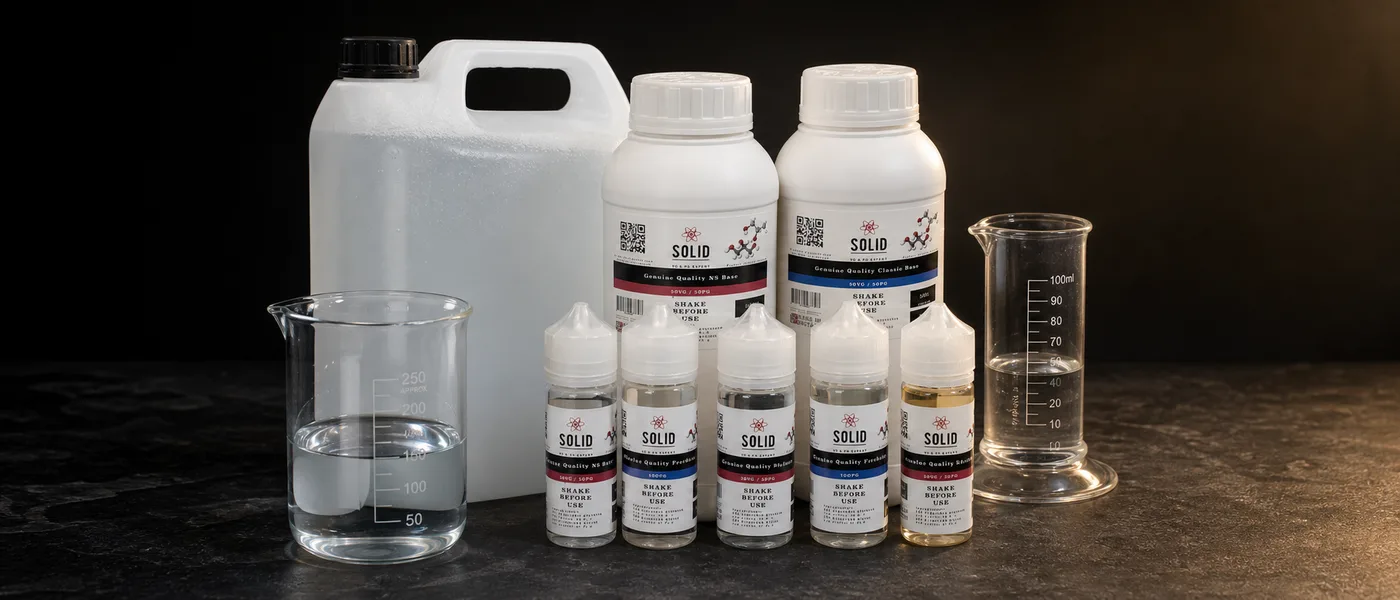
What is an e-liquid base?
An e-liquid base is the unflavoured carrier portion of a finished liquid. It normally contains vegetable glycerine, abbreviated as VG, and propylene glycol, abbreviated as PG. A ready 50/50 base already combines both. Alternatively, separate 100VG and 100PG ingredients let an experienced mixer build another ratio.
The ratio is normally written as VG first and PG second. Therefore, 70VG/30PG means 70 percent VG and 30 percent PG. It does not mean 70mg nicotine, and it says nothing about bottle strength. A base may be nicotine-free or may contain nicotine, so always read the ratio and the mg/ml figure as two separate specifications.
Flavour concentrate and nicotine are not automatically part of a plain 0mg base. Once they are added, their own carrier liquid also changes the final VG/PG balance. This is why a bottle recipe should be calculated from every ingredient rather than from the base label alone.
VG vs PG: the practical differences
VG and PG are both clear carrier liquids, but they behave differently. VG is noticeably more viscous. As a result, it tends to produce denser vapour and a softer-feeling draw. PG is thinner, so it moves through small liquid channels more readily and usually presents flavour and throat sensation more sharply.
More VG
Thicker liquid, denser vapour, and a softer sensory profile. The coil must have enough inlet area and power range to wick it consistently.
More PG
Thinner liquid, less dense vapour, and a firmer throat sensation. Very thin liquid can be unsuitable for a cartridge designed around thicker blends.
Balanced 50/50
A middle point for viscosity and flavour carrying. It is common in refillable pods, but compatibility still depends on the exact cartridge.
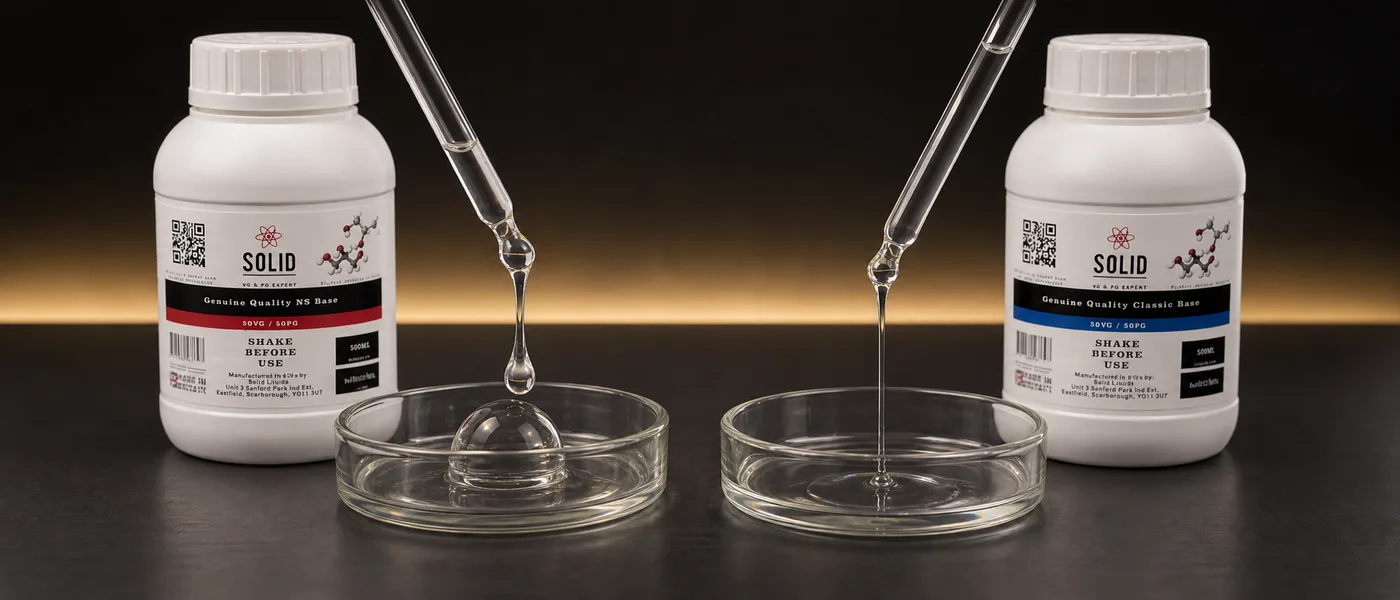
Temperature also matters. A high-VG liquid becomes even slower to flow in a cold environment, while heat makes both carriers less viscous. Consequently, a ratio that wicks comfortably indoors may need more care in winter. Storage, cartridge age, and the amount of sweetener can also affect performance, so ratio is important without being the only variable.
Common VG/PG ratios at a glance
| Label | Relative thickness | Typical starting point | Check before use |
|---|---|---|---|
| 50VG/50PG | Balanced | Many compact pods and MTL coils | Cartridge guidance and nicotine strength |
| 60VG/40PG | Moderately thick | Devices that allow slightly thicker liquid | Wicking speed at the selected power |
| 70VG/30PG | Thick | Many larger, lower-resistance coils | Coil inlet size and minimum recommended power |
| 80VG/20PG or max VG | Very thick | Specialised high-flow setups | Whether the maker explicitly supports it |
| High-PG blend | Thin | Selected older or specialised MTL setups | Leak risk and throat sensation |
These are practical categories, not universal rules. For example, two 0.8-ohm cartridges can have different inlet sizes and power curves. Likewise, one maker may recommend 50/50 while another supports a wider range. Start with the liquid guidance printed for the cartridge or kit, then use resistance and power as supporting information.
How to choose an e-liquid base ratio for your device
Compact refillable pods
Small pods usually contain a small wick and narrow liquid channels. Therefore, a balanced and relatively fluid base is often the easiest place to begin. High-strength nicotine is also commonly used in this hardware, which makes accurate label reading especially important. Do not compensate for poor wicking by repeatedly increasing power.
Traditional mouth-to-lung tanks
MTL tanks cover a wider range of coils. Some work best with 50/50, while others can handle 60VG/40PG. Instead of relying on the MTL label alone, identify the exact coil code and resistance. The vape coil guide explains why resistance by itself does not describe every liquid channel or power requirement.
Larger direct-to-lung setups
Large low-resistance coils commonly have bigger wick openings and operate at higher power. Consequently, they often support 70VG/30PG liquid. Nicotine concentration must normally be much lower than in a compact pod because these devices vaporise more liquid per puff. Never transfer a high-strength pod liquid into a high-output setup simply because its ratio appears compatible.
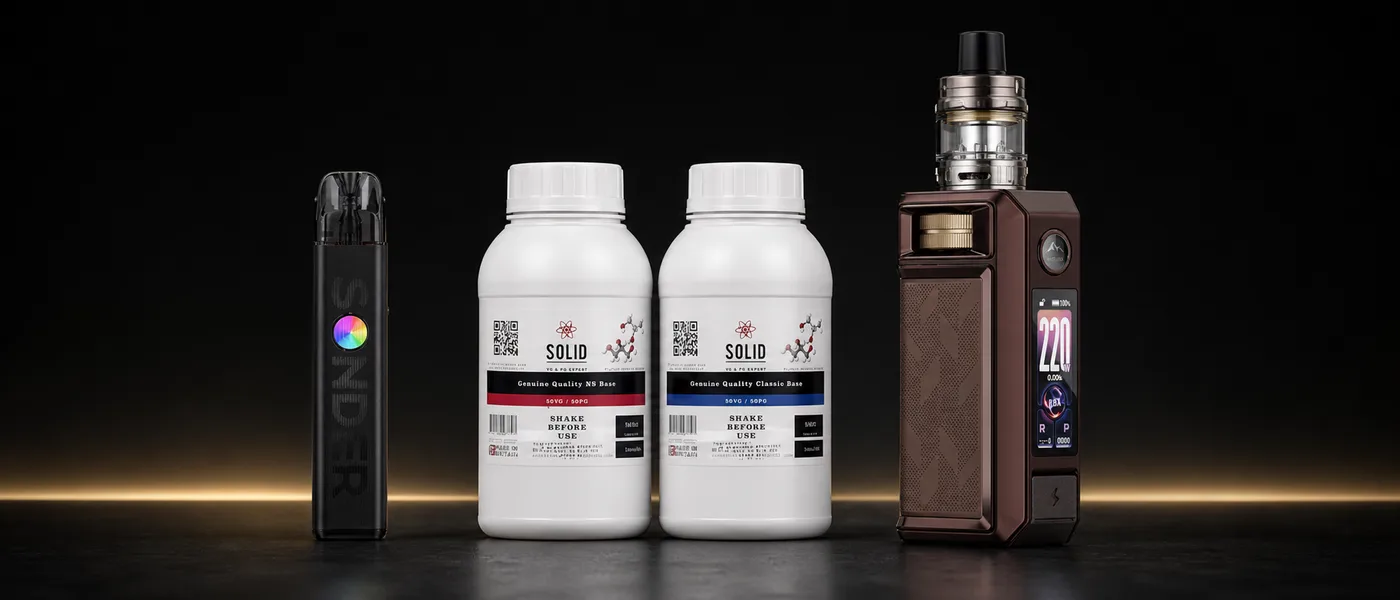
How concentrates and nicotine shots change the ratio
A DIY recipe can start at one ratio and finish at another. Most flavour concentrates use PG as a carrier, although the label must confirm this. Nicotine shots also state their own VG/PG ratio. Therefore, adding a PG-based concentrate and a 50/50 shot to a 70VG/30PG base will reduce the finished percentage of VG.
For a reliable calculation, list the millilitres of VG and PG contributed by every ingredient. Then divide each carrier total by the final bottle volume. For example, 80ml of 70VG/30PG base contributes 56ml VG and 24ml PG. If 10ml of PG-based concentrate and 10ml of 50/50 shot are added, the 100ml recipe contains 61ml VG and 39ml PG, so the final ratio is approximately 61VG/39PG.
That example demonstrates the method only. It does not recommend a nicotine strength or flavour percentage. First follow the concentrate maker’s dosage, then calculate nicotine separately with the nicotine strength calculator guide. Finally, verify that the resulting ratio suits the coil.
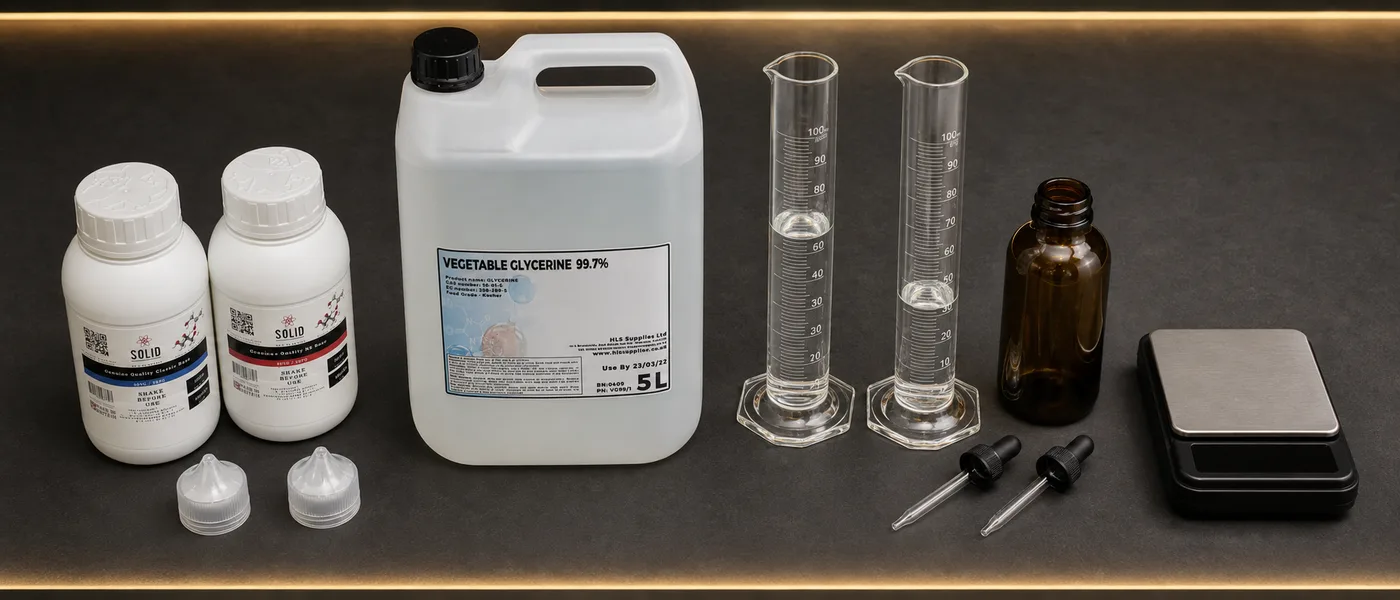
Ready-mixed base or separate VG and PG?
A ready-mixed 0mg base reduces the number of measurements. It is useful when its fixed ratio already fits the recipe. Separate VG and PG offer more control, especially when a concentrate adds substantial PG or when the mixer needs to adjust viscosity. However, extra control also means extra measurements and more opportunities for a transcription error.
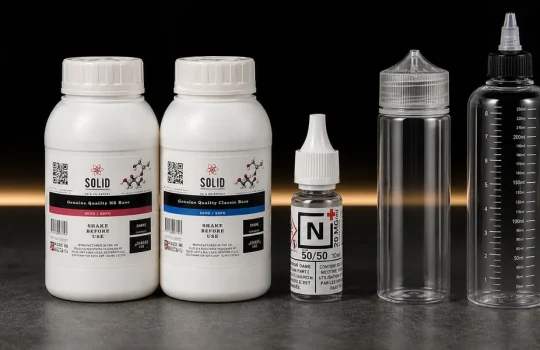
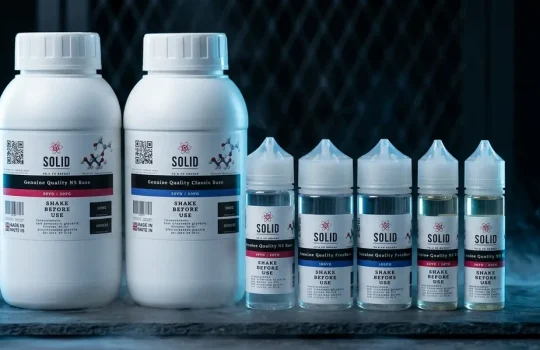
The three live examples below illustrate the choice. Product pages and starting prices were checked on 15 August 2026. Because sizes, prices, and stock can change, confirm the selected variation before ordering.
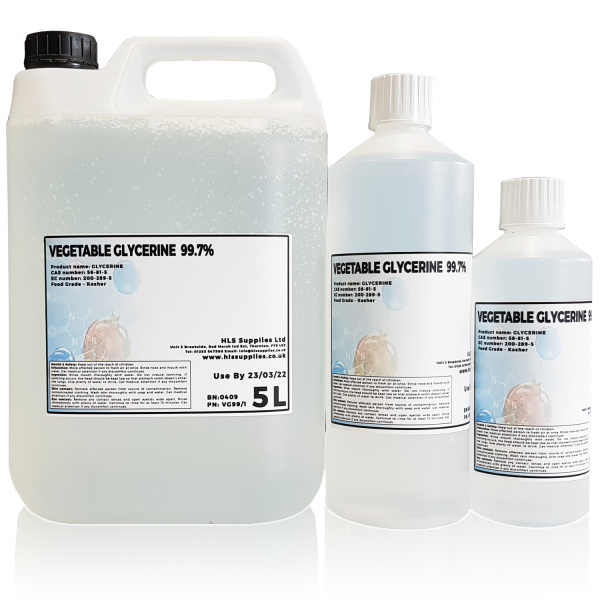
Pflanzliches Glyzerin (VG) 99,5%.
A separate VG ingredient for calculating a custom carrier ratio.
Propylenglykol (PG) 99,9
A separate PG ingredient for flavour-carrier and viscosity calculations.
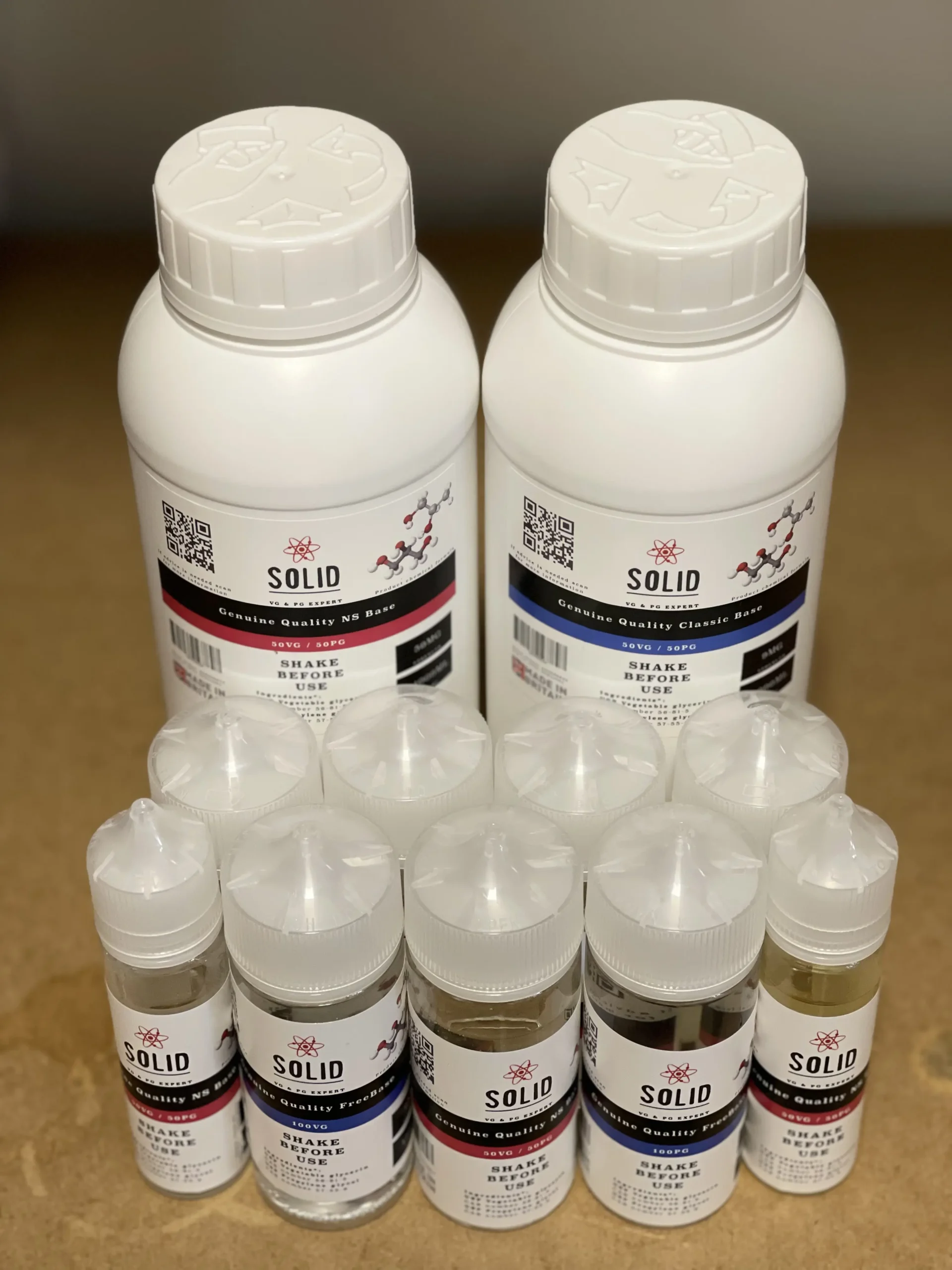
0.0% Base
A nicotine-free balanced base when a custom VG/PG blend is unnecessary.
See all available sizes and strengths in the bases category for Poland. A 0mg product contains no nicotine, while a nicotine-containing base requires additional handling and strength checks.
Five ratio mistakes to avoid
- Reading the numbers backwards: VSHUB24 listings use VG first, but always confirm the label instead of assuming.
- Ignoring the other ingredients: concentrate and nicotine carriers can move the finished ratio away from the starting base.
- Choosing by cloud size alone: a thick liquid is a poor choice if the wick cannot replenish between puffs.
- Treating ohms as the whole answer: inlet size, coil material, power range, and manufacturer guidance also matter.
- Changing several variables together: change one ratio, coil, or power setting at a time so the result is understandable.
The practical verdict
The best ratio is the one that feeds the exact coil consistently at its intended power. Overall, 50VG/50PG is a useful reference for many compact pods, whereas 70VG/30PG is a common reference for larger high-flow coils. Neither is universally better.
Start with the device guidance, account for every ingredient, and calculate the final ratio rather than the starting base alone. Next, use the DIY e-liquid base guide for the mixing workflow and the nicotine types and strengths guide before adding nicotine.
Häufig gestellte Fragen
What is the best VG/PG ratio for a pod?
Many compact pods are designed around relatively fluid 50VG/50PG liquid. However, cartridges differ, so check the exact manufacturer’s liquid guidance. Do not infer compatibility from resistance alone.
Is 70VG/30PG better than 50VG/50PG?
No ratio is universally better. A 70VG/30PG liquid is thicker and commonly suits larger high-flow coils, while 50VG/50PG is more fluid and often suits compact pods. The coil decides which is appropriate.
Does VG/PG ratio tell me the nicotine strength?
No. VG/PG describes carrier proportions, while nicotine strength is shown separately in mg/ml or sometimes as a percentage. For example, a 50VG/50PG base can be 0mg or can contain nicotine.
Does flavour concentrate change the final VG/PG ratio?
Yes. A PG-based concentrate adds PG to the recipe, and a nicotine shot adds the carriers printed on its label. Calculate the VG and PG contributed by every ingredient to find the finished ratio.
Can I mix 100VG and 100PG myself?
Yes, an experienced adult mixer can combine measured VG and PG to make a target carrier ratio. Use accurate equipment, record the recipe, and remember that concentrate and nicotine components can change the final balance.
Why does high-VG liquid taste burnt in a small pod?
A thick high-VG liquid may replenish a small wick too slowly, especially during frequent puffs or in cold conditions. Stop using a burnt-tasting cartridge, check the supported ratio, and replace the coil if it has been damaged.
Continue with the e-liquid base cluster
For adults only. Plain 0mg VG, PG, and nicotine-free base do not contain nicotine. Nicotine-containing bases and shots are addictive and require careful handling. Keep all ingredients secured away from children and pets, follow product labels and local rules, and never estimate nicotine quantities by eye.